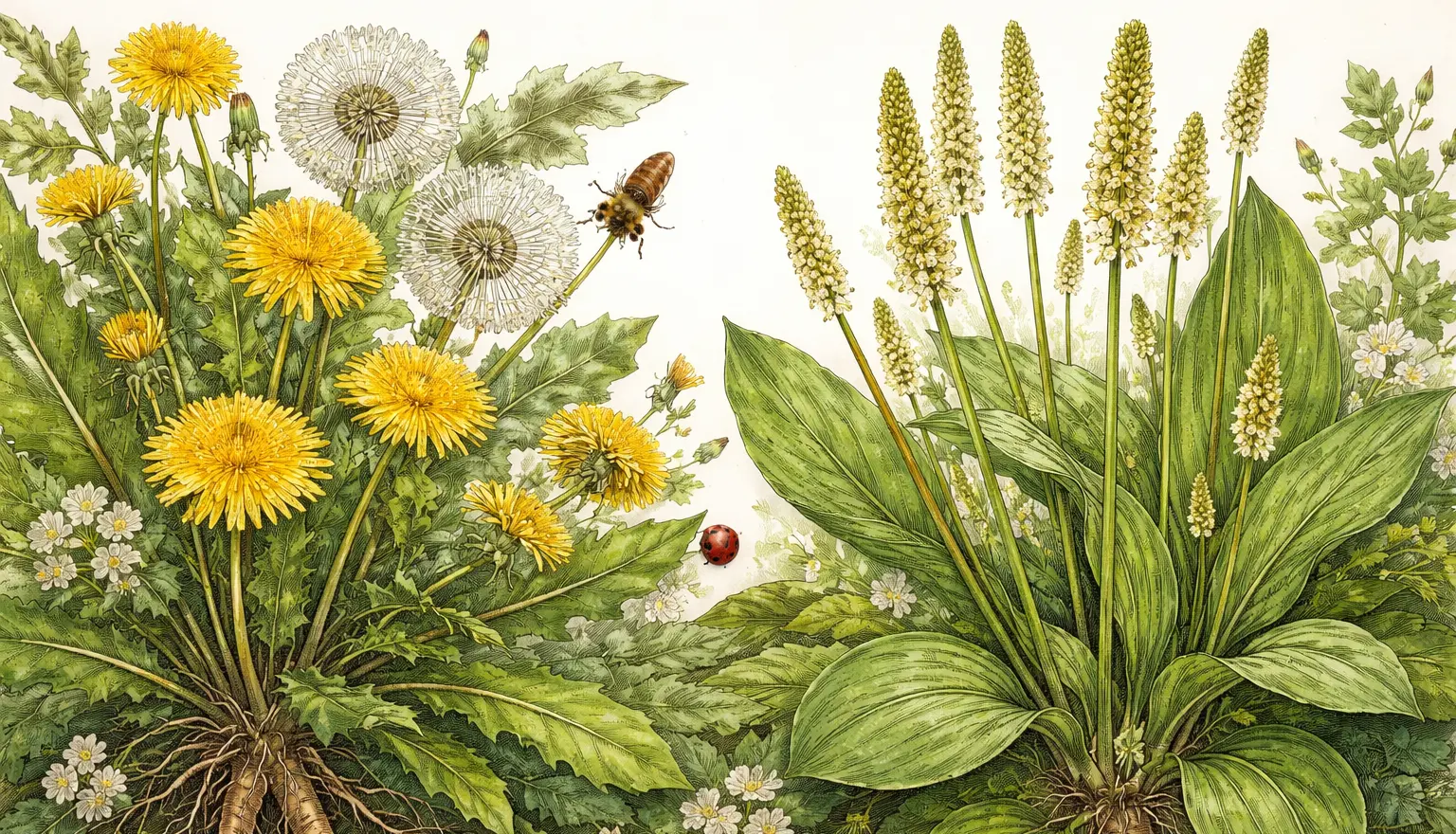
There is something rather admirable about the plants we so often call weeds. Dandelions lighting up a patch of grass, or plantain quietly spreading along a well-trodden path, seem to arrive uninvited and stay with great determination. Yet beneath this persistence lies a quiet and rather remarkable story.
In the natural world, plants live in constant negotiation with their surroundings. Dry soil, curious insects, wandering feet, and changing weather all play their part. To meet these challenges, many humble plants have developed intricate chemical gifts that help them endure. These natural compounds protect, restore, and sustain the plant through each season.
What is especially pleasing is that some of these same qualities can be of use to us. When approached with care and respect, these familiar plants offer gentle support for digestion, skin, and general wellbeing. It invites one to pause before pulling them up, and perhaps to see them as companions rather than intruders.
What we mean when we say weed
A weed is not a botanical category. No plant is born one. The word describes a relationship, and the relationship is entirely ours: a weed is a plant growing somewhere a person would rather it did not. Move the boundary of the bed by a foot and the same plant changes its status without changing at all.
This is worth holding onto, because it reframes the question. The plants that colonise a disturbed allotment bed are not failures of tidiness. They are the plants best suited to the conditions we have created. Bare soil is an unnatural state, and nature closes it as quickly as it can. Every gardener who has turned a bed in March and found it green by May has watched this happen.
What follows is an argument for curiosity rather than tolerance. You may still want the dandelion out of your carrot row, and that is entirely reasonable. But it is more satisfying to remove a plant you understand than one you merely resent.
The cheerful dandelion
The dandelion, with its bright face and deep-set root, is a model of quiet resilience. Beneath the soil, its root stores nourishment that carries it through winter and helps it return each spring.
Start with the name, which is a small piece of preserved observation. Dandelion comes through French from dent de lion, the lion’s tooth, after the jagged margins of the leaf. The French themselves largely abandoned that name in favour of pissenlit, which translates with unembarrassed directness as wet-the-bed. English dialect kept the same idea in piss-a-bed. Both names record the plant’s long reputation as a diuretic, which is to say that country people worked out its effect on the body and named it accordingly, several centuries before anyone isolated a compound.
A hundred flowers pretending to be one
The bright yellow head is not a flower. It is a composite, an inflorescence made of many separate flowers packed onto a single disc, each one complete with its own petal, its own stamens, its own ovary. A well-fed dandelion head can carry a hundred and fifty or more of these florets. When you blow the clock and watch the seeds go, you are watching the result of a hundred and fifty individual flowerings.
Stranger still is how those seeds are made. Most dandelions in Britain do not bother with sexual reproduction at all. They set seed by apomixis, producing viable embryos without fertilisation, so that every seedling is a genetic copy of its parent. A dandelion is, in effect, a plant that photocopies itself.
This has an odd consequence for botanists. Because each lineage breeds true and never mixes, small variations become permanent, and the plant fragments into hundreds of near-identical microspecies. Britain and Ireland have more than two hundred recognised. The dandelion on your path and the dandelion on mine may belong to entirely different microspecies, and telling them apart is specialist work that turns on the shape of the outer bracts and the colour of the pollen. Most of us are content to call the whole business Taraxacum officinale and move on, but it is pleasing to know that the mat of yellow across a Dartmoor field may be a crowd of separate lineages standing shoulder to shoulder.
The seed and its curious flight
For a very long time the dandelion clock was admired without being understood. The pappus, that little parachute of fine bristles, is mostly empty space. Something like nine tenths of the disc it forms is gap rather than filament, which by ordinary reasoning ought to let air rush through and provide almost no lift at all.
In 2018 a research group at the University of Edinburgh worked out what actually happens, and published it in Nature. As air passes through the bristles it forms a detached ring of circulating air that sits in the wake just above the seed, a structure they named a separated vortex ring. It is stable, it holds its position, and it is an extraordinarily efficient way to stay airborne. Nothing quite like it had been described in flight before, in nature or in engineering.
The practical result is that dandelion seed can travel a very long way on a light wind. When you look at a plant that has appeared in the middle of a well-kept bed and wonder where on earth it came from, the honest answer may be several fields away.
The root, and what is stored in it
Below ground the dandelion runs a taproot that can reach well past the depth most of us dig. This is the source of the gardener’s frustration. Snap it, as almost everyone does, and the fragment left behind will regenerate a whole new plant from its crown. Hoeing a dandelion patch without lifting the roots is closer to propagation than to weeding.
Its leaves and roots contain naturally bitter elements. In the plant, these discourage grazing animals. For us, these bitters can gently encourage digestion by supporting the flow of saliva and digestive juices. A simple infusion or decoction has long been valued for this purpose. This is also why the traditional English preparations tend to be bitter drinks taken before or after a meal rather than during it, and why dandelion turns up alongside burdock in the old cordials.
Dandelion also carries antioxidant compounds that help it manage sunlight and environmental stress. These same properties are thought to support the body’s natural balance and calm minor inflammation.
By autumn, the root becomes rich in inulin, a form of stored energy. Inulin is a carbohydrate the plant lays down to fund next spring’s growth, and its concentration climbs through the season, which is precisely why the old advice is to lift roots in autumn rather than spring. It is also not digestible by us in the ordinary way. It passes through to the large intestine largely intact and is fermented there by gut bacteria, which is the mechanism behind its reputation as a prebiotic. Anyone who has enthusiastically eaten a lot of Jerusalem artichoke, which stores the same compound, will have discovered the other consequence of that fermentation.
Roasted and ground, the autumn root makes a passable coffee substitute, a use that became widespread in Britain during wartime shortage and has never entirely gone away.
A digression on tyres
The white sap that beads on a broken dandelion stem is latex, and latex means rubber. This is not a curiosity of no consequence. During the Second World War, when access to rubber plantations was cut off, the Soviet Union cultivated a Central Asian relative, Taraxacum kok-saghyz, on a serious scale specifically for its rubber content. The programme worked, though it could not compete on cost once normal supply resumed.
It has since been revived. Rubber remains a crop grown mostly in a narrow tropical band, on trees vulnerable to disease, and a temperate alternative that can be grown in rotation on ordinary farmland is strategically interesting. Tyre manufacturers have produced working prototypes from dandelion rubber over the past decade.
None of which helps with the ones in your onion bed. But it is worth knowing that the plant you are levering out with a daisy grubber is, in another context, an industrial crop under active development.
The steadfast plantain
Plantain is often found where the ground is firm underfoot. It settles into paths and edges, thriving where other plants hesitate. Its broad leaves hold a subtle strength.
Two species account for nearly everything you will meet on an allotment. Greater plantain, Plantago major, has broad oval leaves flat to the ground and a long green flower spike like a rat’s tail. Ribwort plantain, Plantago lanceolata, has narrow strap-shaped leaves with strong parallel ribs and a short dark flower head ringed with pale stamens. Both are useful. Ribwort is the one children have used for generations to play soldiers, hooking one stalk behind another and pulling to knock the head off.
That habit of growing flat is the whole strategy. A plantain rosette presses its leaves against the ground, keeps its growing point at soil level, and simply endures being walked on and mown over. Where competition comes from plants that grow upward and get flattened, plantain wins by never having stood up in the first place.
Waybread, and the footprint it followed
The plant is old in English. Its Old English name was wegbrade, waybread, the bread of the way, after exactly the habit of growing along paths that we still see. It appears in the Nine Herbs Charm, an Anglo-Saxon remedy preserved in the manuscript known as the Lacnunga, where it is addressed directly and praised for having withstood being run over by carts and trampled by feet. Someone was watching this plant carefully more than a thousand years ago and reached much the same conclusion we do.
Its seeds turn mucilaginous when wet, which makes them cling to boots, hooves and cart wheels. The result is that plantain travelled wherever Europeans travelled. In North America it arrived with settlement and spread along the routes settlers took, and several indigenous peoples named it accordingly: White Man’s Footprint, or Englishman’s Foot. Longfellow put the name into The Song of Hiawatha. It is a common weed that carries a genuine record of colonisation in its name, which is a heavy thing for a plant most of us step over without noticing.
What is in the leaf
When the leaf is damaged, it releases compounds that protect it from infection. In traditional use, a freshly crushed leaf placed on the skin has been valued for soothing minor cuts, stings, and irritations. There is a long history of this simple practice in country gardens and hedgerows, and it is the single piece of folk herbalism most likely to be known by people who know no others.
Two of the constituents behind that reputation are reasonably well characterised. Aucubin is an iridoid glycoside with documented antimicrobial activity. Allantoin has a long record of use in skin preparations, where it is associated with encouraging cell turnover. Neither makes plantain a medicine, but they do mean the traditional practice is not built on nothing.
Plantain also contains a gentle mucilage, a soft and moistening substance. This helps the plant retain water in dry conditions. For people, it offers a soothing quality, whether used on the skin or prepared as a mild infusion. The connection worth making here is that psyllium, sold in every health food shop as a bulk fibre, is the seed husk of Plantago ovata, a plant in the same genus. The mucilage in the leaf of the plantain on your path is a relative of the one sold by the tub.
What the weeds are telling you
Beyond their own interest, these plants are diagnostic. A plant establishes where conditions suit it, so a strong population is a reading of the ground.
Plantain in particular is a reliable indicator of compaction. It tolerates dense, airless soil that most plants cannot root into, so where you see it thriving in quantity, the soil beneath is likely to be tight. On an allotment this usually maps precisely onto where people walk: the line between beds, the turn by the shed, the route to the water butt. Plantain is not causing the problem, it is reporting it. The response is not weedkiller but a board to walk on, a proper path, or a fork through the affected ground in autumn.
Dandelion tells a less specific story, being tolerant of a great deal, though a heavy flush usually points to bare or recently disturbed soil with light to spare. Its deep root does genuinely reach nutrients in the subsoil that shallower plants cannot. You may see this described as dynamic accumulation, with the plant said to lift minerals for the benefit of its neighbours. Treat that claim gently. The roots do reach deep and the leaves do return organic matter when they die back, but the stronger versions of the idea have thinner evidence beneath them than their confident repetition suggests.
There is also the matter of what the dandelion feeds. It flowers early, often before much else is open, and a mown lawn left alone through April will support a good deal of insect life that a shorn one will not. The caution here is that dandelion pollen alone is not a complete diet for honeybees, so this is an argument for dandelions as part of an early forage rather than as a solution by themselves.
A thoughtful approach to gathering
If one chooses to gather these plants, it is wise to do so with care. Select clean areas away from roads and treated ground. Take only what is needed, and leave plenty behind so the plants may continue to flourish.
One caution is worth stating plainly, because it follows from where these plants like to grow. Plantain colonises path edges and verges, and roadside verges accumulate everything that comes off the road, so leave those alone entirely. The allotment paths are a different matter and perfectly good ground to gather from, dogs not being permitted on the site. Away from the allotment, use your judgement about who else uses a path before picking a leaf you intend to put on a wound or in your mouth.
Be certain of what you have. Dandelion has several common lookalikes, notably cat’s ear and the hawkbits, which share the yellow composite head. None of them is dangerous, so the risk is disappointment rather than harm, but the identification is easy enough to be worth doing properly. A true dandelion has all its leaves in a basal rosette, a single hollow leafless stem carrying one head, no hairs on that stem, and milky sap when it is broken. The lookalikes generally fail at least one of these, most obviously by having branched or hairy stems.
Timing has its own quiet importance. Young dandelion leaves in spring are tender and pleasantly bitter, and they grow more bitter as the season goes on and the plant flowers. The old market gardener’s trick is to blanch them, covering the crown with a pot for a fortnight so the new growth comes up pale and mild. Roots are best lifted in autumn when their stored goodness is at its peak, for the reason given above. Plantain leaves may be gathered through the growing season, choosing young ones, though many find them especially useful later in the year.
Simple preparations are often the most satisfying. A slow simmer of dandelion root draws out its deeper qualities, while plantain leaves can be gently infused in oil over time, creating a soothing preparation for the skin. Neither asks for equipment beyond a pan and a jar.
Sensible cautions
This is a gardening article and not medical advice, and the distinction matters more here than in most of what we write. A few points are worth setting down.
Dandelion belongs to the daisy family, so anyone with a known sensitivity to that group, which includes chamomile and ragweed, should treat it carefully. Its diuretic effect is real rather than decorative, which means it can interact with prescribed diuretics and with lithium. Bitter herbs that stimulate bile flow are generally not advised for anyone with gallstones or a bile duct problem. If you take regular medication or are pregnant, the sensible course is a word with a pharmacist or GP before making these a habit rather than an occasional curiosity.
Plantain used on unbroken or lightly grazed skin has a good safety record and a very long history. That is not the same as a sterile dressing, and a wound that is deep, dirty, or not healing needs proper attention rather than a leaf.
None of this is a reason to leave the plants alone. It is a reason to treat them as what they are, which is potent enough to be interesting and therefore potent enough to deserve respect.
A closing thought
An allotment is a place of learning as much as growing. The plants that arrive of their own accord often have something to teach, if we are willing to look a little closer.
There is a version of gardening that consists of imposing a plan on a piece of ground and defending it. There is another that involves reading what the ground is already doing and working with the grain of it. Most of us practise some mixture, and the weeds are where the two meet. The dandelion in the path is information. The dandelion in the carrots is a nuisance. It is the same plant, and knowing something about it makes both encounters better.
Dandelion and plantain ask very little, yet offer quite a lot in return. With a touch of curiosity and a measure of respect, they may find a small and welcome place among our cultivated beds.