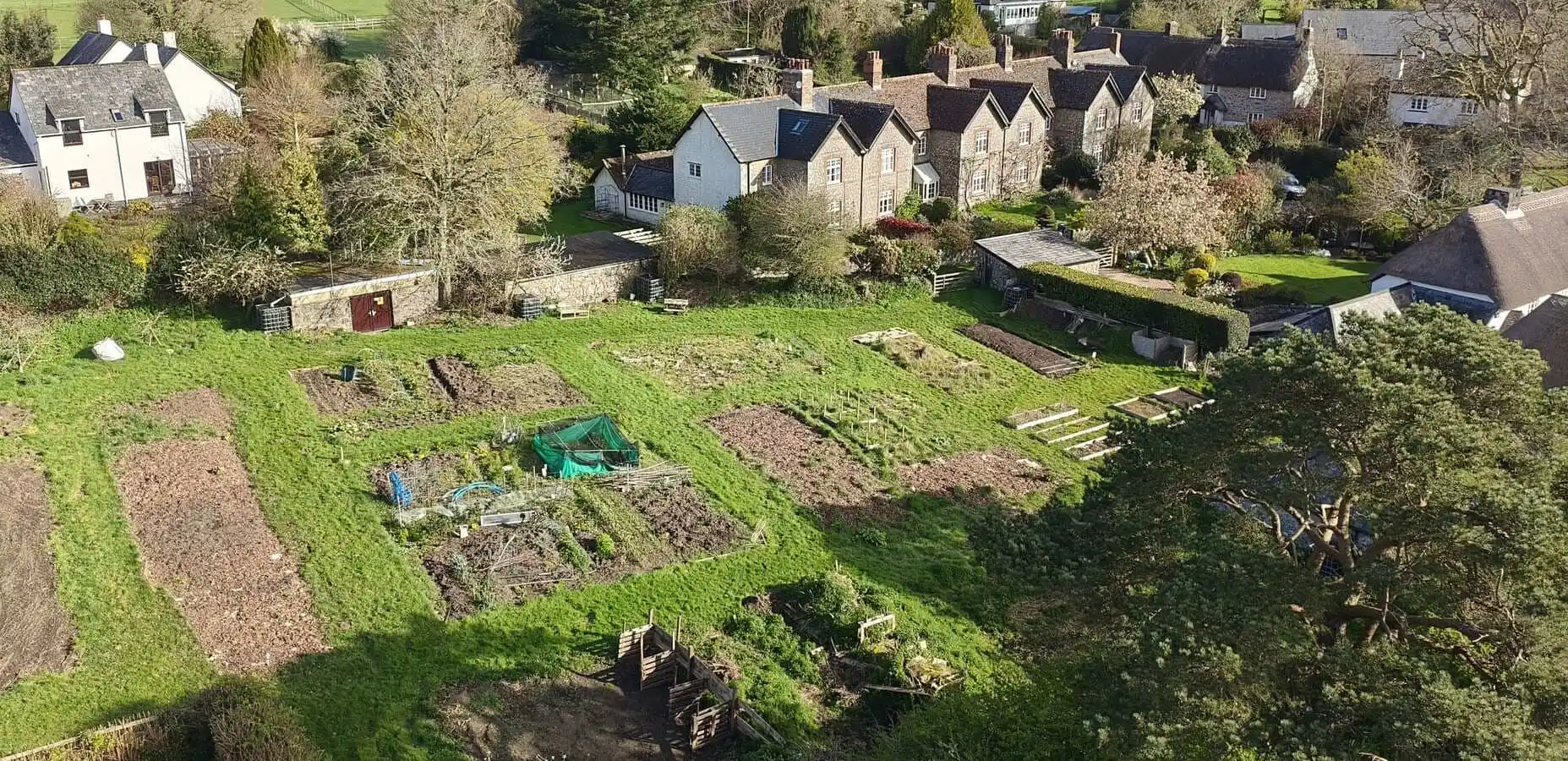
The North Bovey allotments sit on land belonging to St John's, at the edge of Dartmoor. Thirteen plots on the current plan, running from raised beds of a metre or so up to something nearer nine metres by ten. It is not a large site. For several years it was mainly left to the insects. Since last year it has been coming back.
St John's ground
The land belongs to St John's, which stands just off the green, a minute up the lane. There has been a place of worship on that site for something like eight hundred years. The chancel is thirteenth century, most of the rest fifteenth, and the list of known rectors runs back to the twelve hundreds. It is granite, as everything here eventually is, and there is a tinners rabbit on one of the roof bosses if you know to look up.
What matters for the allotments is not the age of the building but the habit that comes with it. Villagers turn out to clean the church and keep the churchyard in order, and have done for as long as anyone has bothered to write it down. Ground looked after by whoever happens to be free that morning is not a new idea in North Bovey. It is more or less the arrangement.
Nobody can now say when growing started on this particular field, only that it has been going on a long time and that the church has held it throughout. That is why the Parochial Church Council sits on our committee. We are working somebody else's land with their blessing, and it is the reason this field is still a field.
A revival!
Allotments need attention and when people stop renewing, one or two a year, for perfectly good reasons, and then nobody takes the vacant plot. The following spring there is more to clear than there was, so the plot after that is harder to let, and so on.
By the end of it the water butts were standing stagnant, the plots were growing over, and the compost bays had become permanent housing for nettles and dock. The site felt smaller. That might have been the end of it: a quiet field returning to rough ground.
A few in the village decided to do something about it. They cleared the plots, and the shed, and the compost bays. They started to bring the ground back into use, and thought about what people wanted from a local space to grow something special. Our role was to listen, and to help them make it happen. The allotments are now a community project, and the village is bringing them back, plot by plot. With a committee, and a treasurer to make decisions, we're crafting an invitation that nobody can refuse.
What makes North Bovey unique
Not short of ground. Short of time.
Most allotment sites exist because people have nowhere else to grow. That is not really our situation. Most households in North Bovey have a garden with room enough for beans and potatoes if they want them. What people here are short of is not land but hours.
So we have stopped assuming that a plot means a full season of digging, and started asking a different question: what is this ground for, if not self-sufficiency? The answers we keep arriving at are company, a reason to be outside, somewhere for the village to put its hands to something together, and a corner of the parish that is better for insects and birds than a mown lawn would be.
That makes us slower than a conventional site, and a good deal more informal. It also means there is a way in for people who could never commit to a full plot. An afternoon on a work day counts. Watering someone else's row while they are away counts.
We may as well say the obvious thing plainly, because it is the truest thing about the place. Being outdoors, doing something with your hands, in the company of people you would not otherwise have met, is good for you. It is good for people who live alone. It is good in winter. Nobody needs a doctor to explain why, and we are not going to pretend the vegetables are the reason anybody keeps coming back.
It also sets the aim we keep coming back to. A larger, older allotment site accumulates things over time: plots of every size, raised beds, shared infrastructure, a corner for whatever nobody else has room for. We want that whole range here, on thirteen plots and a small village's worth of people. The smallest plot we can cut. A single raised bed. A shared plot, which the committee has now agreed to offer. Involvement measured in contribution rather than tenancy, for anyone who cannot take on ground of their own. A community bucket, if a bucket is what brings somebody up here for an hour a month. The unit is not the plot. The unit is the hour.
Put together, that is the shape of this place: a thirteen-plot field held by the church for longer than anyone can date, inside a National Park, in a village that does not need the vegetables and keeps the allotments anyway. We are not rebuilding a food supply. We are rebuilding a reason for people to be in the same field.
Starting again
What happened instead was that a few people decided to rebuild the allotments as a community project rather than simply re-let them. That distinction has mattered at every step since. Plots that had gone over were cleared, some of them by volunteer groups who gave whole days to it. Interest has grown steadily. Ground that had not been turned in years is workable again.
There is a shed again now, bought rather than inherited, and a new picnic table. That sounds like a small thing and is not. A table is somewhere to put the flask down. It is the difference between people working near each other and people sitting together.
Progress is slow and we would rather say so than pretend otherwise. This summer has been dry, and a dry season on thin Dartmoor soil sets its own pace. Some plots are further on than others. Some are still waiting for someone to take them on.
What we are working towards
The Vision for Dartmoor sets a direction for the National Park out to 2045: a thriving and resilient landscape where nature, farming, communities and heritage all do well, and where anyone is welcome to live, work or visit. A thirteen-plot allotment is a small thing to set beside a vision for a whole National Park. But small things joined up are more or less what it describes.
So our aims are modest and specific. Bring the remaining plots back into use. Offer a range of plot sizes wide enough that almost anyone can find a way in. Make this somewhere people want to spend an hour, not just work an hour. Get the pond in and the hedgehog houses sited, and work out from there what else this ground should do for wildlife, which is a live argument here and not a settled one. Leave the ground in better condition than we found it, for whoever is holding these plots in twenty years.
Doing all of that costs more than subscriptions raise. What we have paid for so far, and what we are raising for next, is set out on the funding page.
Who looks after it
The association is run by a committee drawn from the village and from the Parochial Church Council, with a chair, a secretary, a treasurer and a safeguarding lead. Names, roles and how to reach any of them are on the contact page.
Coming in
There is no single way to be involved. Some people hold a plot. Some come to work days. Some have taken on one bed rather than a whole plot, which suits a first year better than most people expect. Nobody is turned away for not knowing what they are doing, and most of us did not.